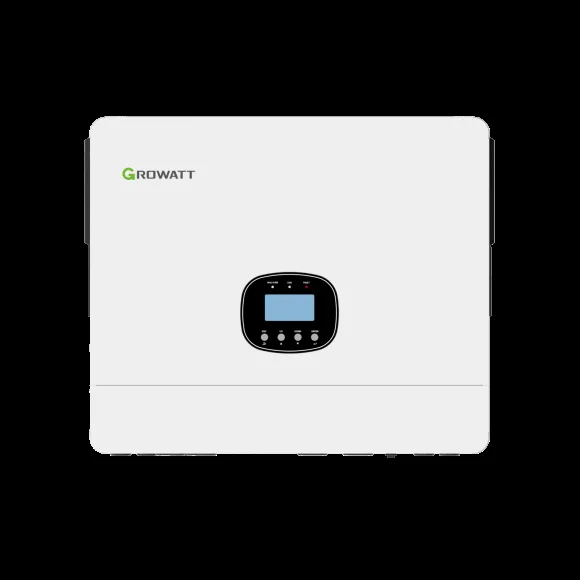
Growatt Spe 8000~12000Es
Standalone operation is the purpose of Growatt's SPE ES platform. The datasheet classes it as an off-grid energy storage inverter, built to run a load from batteries and photovoltaic input rather than to export into a utility connection, and the 8000 to 12000 span in its name covers several ratings on one design.
On the solar side, two MPPT channels accept a maximum DC input voltage of 550 V. That window suits the shorter strings typical of standalone and backup work: remote cabins, telecom huts, farm buildings and premises where the grid is unreliable or simply absent.
Battery-coupled storage, dual trackers and a moderate DC ceiling together describe a unit designed for autonomy rather than for maximum grid yield. Output power, efficiency and enclosure ratings have not been verified for this family and are left blank instead of estimated.
Technical Specifications
| Maximum DC Input Voltage | 550 V |
| Number of MPPT Channels | 2 |
| Inverter Type | 离网储能逆变器 |
Frequently asked questions
What type of inverter is the Growatt SPE 8000-12000ES?
Growatt catalogues the SPE 8000-12000ES as an off-grid inverter for battery-based energy storage, in the same SPE and SPF group as the brand's other stand-alone models. The designation names an 8 to 12 kW family rather than one wattage, so this entry describes the class of unit, not a single fixed power rating.
What is the maximum DC input voltage of the Growatt SPE 8000-12000ES?
The Growatt SPE 8000-12000ES accepts up to 550 V of maximum DC input voltage. PV or battery strings feeding this model need to stay under that ceiling at the coldest expected temperature, when open-circuit voltage rises, which in practice limits how many modules or battery cells can be wired in series on each input.
How many MPPT inputs does the Growatt SPE 8000-12000ES have?
The Growatt SPE 8000-12000ES has two MPPT channels, letting the off-grid system draw from two separately tracked PV inputs at once. That is useful where the array is split across two roof faces or tilt angles, since each input finds its own maximum power point instead of the whole array being limited to the worst-performing string.
Source: www.growatt.com