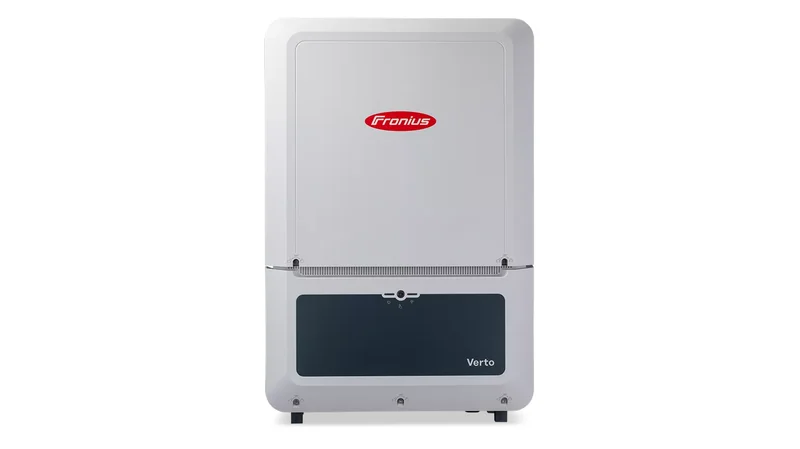
Fronius Verto 33.3
Commercial solar installations demand reliable, high-performance inverters that can handle substantial power loads while maintaining exceptional efficiency. Austrian engineering excellence shines through in this 33.3kW three-phase solar inverter, delivering maximum efficiency of 97.47% with European efficiency rated at 97.36%. This transformerless inverter features four independent MPPT channels, each capable of handling up to 28A DC input current, providing optimal energy harvesting across varying conditions.
Built for demanding commercial environments, this inverter operates reliably across an extended temperature range from -40°C to +60°C with robust IP66 protection against dust and water ingress. The wide MPPT voltage range of 150-870V accommodates diverse solar array configurations, while multiple AC output voltage options (380/220V to 480/277V) ensure compatibility with various grid standards. At 38.9kg, this professional-grade inverter combines substantial power handling with practical installation considerations for commercial solar projects.
Technical Specifications
| Nominal AC Power | 33300 W |
| Maximum AC Power | 33300 W |
| Maximum Efficiency | 97.47 % |
| European Efficiency | 97.36 % |
| MPPT Voltage Range | 150-870 V |
| Maximum DC Input Voltage | 600 V |
| Number of MPPT Channels | 4 |
| Maximum DC Input Current per MPPT | 28 A |
| AC Output Voltage | 380/220V, 400/230V, 440/254V, 480/277V V |
| Weight | 38.9 kg |
| Enclosure Protection Rating | IP66 |
| Operating Temperature Range | -40 to +60 °C |
| Inverter Type | Trafolos |
| Number of Phases | 3 |
Frequently asked questions
What size solar array does the Fronius Verto 33.3 suit?
The Fronius Verto 33.3 is rated at 33300 W of nominal AC power, with the same 33300 W as its maximum, so there is no output boost beyond the nameplate. It is a three-phase unit aimed at commercial rooftops of roughly thirty-three kilowatts, usually with the array oversized to keep the inverter busy off-peak.
How many MPPT trackers does the Fronius Verto 33.3 have?
The Fronius Verto 33.3 has four MPPT channels, each rated for 28 A of DC input current. Four trackers allow a commercial roof to be broken into separate orientations, pitches or shading zones, each optimised on its own, while the 28 A per channel sets how many strings can be paralleled onto one input.
What DC voltage limit governs string design on the Fronius Verto 33.3?
Two figures are recorded for the Fronius Verto 33.3: an MPPT range of 150 V to 870 V and a maximum DC input voltage of 600 V. The lower 600 V value is the absolute ceiling a string must never exceed at the coldest expected temperature, so it is the one that limits how many modules go in series.
How efficient is the Fronius Verto 33.3?
The Fronius Verto 33.3 is rated at 97.47 percent maximum efficiency and 97.36 percent European efficiency. The two are barely a tenth of a point apart, which means the conversion loss of around two and a half percent holds steady at part load instead of appearing only when the inverter runs flat out.
Which grid voltages can the Fronius Verto 33.3 work with?
The Fronius Verto 33.3 lists four alternative three-phase configurations: 380/220 V, 400/230 V, 440/254 V and 480/277 V. Each pair is the line and phase voltage of one four-wire network, not two separate options, so the same hardware covers European, North American and other commercial supplies once configured for the local grid.
Can the Fronius Verto 33.3 be installed outdoors?
The Fronius Verto 33.3 is rated IP66 and specified from -40 to +60 degrees Celsius, a range that covers outdoor mounting in severe cold as well as hot rooftops. At 38.9 kg it needs two installers or a lifting aid, and its transformerless design keeps that mass down for a thirty-three kilowatt machine.
Guides that cover this model
Source: www.fronius.com